Finanzy
An investment simulation lab: bots with different strategies, real market data, explanations always in plain language. No real order is ever executed.
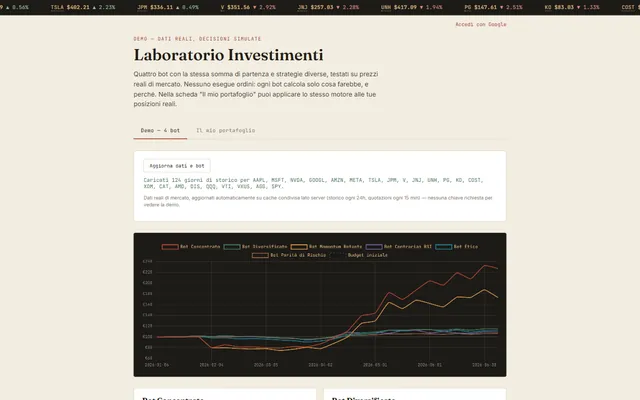
Finanzy started from a distrust: trading bots promise numbers, almost never explanations. They tell you «buy» or «sell», but not why. I wanted the opposite — a place where the decision matters less than the reasoning behind it, where you can watch a strategy think out loud before it ever asks you for a euro. So Finanzy is not a broker and doesn't want to become one: it is a simulation lab, a tool to understand how strategies work, not to run them with real money.
One rule above all: no real orders
It is the principle everything else is built on, repeated on every screen and in every sensitive line of code: Finanzy never places a real order. No endpoint touches a broker, no bot has access to credentials that move money. Even the positions a user records are purely informational — bought elsewhere, on Directa or Trade Republic, and only tracked here. I wanted this constraint to be structural, not a promise: to betray the original idea tomorrow I would have to rewrite the application, not flip a setting.
Six rule-based strategies
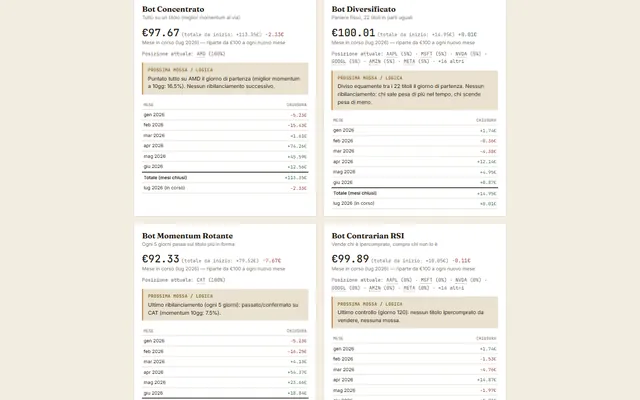
The heart of the public demo is six bots, each with a different philosophy, trading the same basket of genuinely buyable stocks and ETFs (the kind you would find on Trade Republic or Scalable Capital) so you can see how opposite approaches react to the same prices:
- Concentrated — at the start it bets everything on a single stock, the one with the best 10-day momentum, and never rebalances again.
- Diversified — splits the budget equally across a fixed basket, to lower risk.
- Rotating Momentum — every so many days it moves to the strongest stock of the moment.
- Contrarian RSI — does the opposite of the crowd: sells what is overbought and buys what is not.
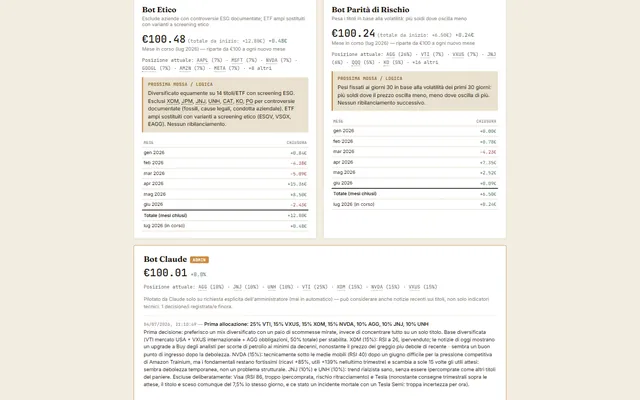
- Ethical (ESG) — excludes companies with documented controversies (fossil fuels, lawsuits, corporate conduct) and swaps broad ETFs for ethically screened variants.
- Risk Parity — weights each holding inversely to its volatility: more capital where it swings less.
They are not black boxes: each bot computes real indicators — RSI, moving averages, momentum, price/earnings ratio — and every move comes with a plain-language explanation. To keep the comparison honest, every bot restarts from €100 at the beginning of each month: so by month's end you can see which strategy did best on equal terms. The idea is that you don't just have a number, you have understood why that number.
Real data, not made up
The prices are not simulated: they come from Alpha Vantage through a server-side PHP proxy, with a cache that reduces external calls — 24 hours for historical data, 15 minutes for quotes. That way, even on a single shared API key, the public demo stays stable and doesn't burn the daily quota on the first visitor. Registered users will be able to enter their own Alpha Vantage key — stored encrypted, never returned to the frontend — for their own simulations, without eating into the shared quota.
The different player: a bot piloted by an AI
Alongside the six rule-based bots lives another, of a different nature: its decisions don't follow a formula, they are proposed by Claude, Anthropic's AI. It is a public demo portfolio, started on 4 July 2026 with a simulated €100, whose state and full decision history anyone can read — the read endpoint is public on purpose.
But the part I am proudest of is how it doesn't work. The Claude bot never runs automatically. There is a switch that is off by default, and even with the switch on every turn stays a manual action: it fires only when I trigger it myself, explicitly, in a session, through a key-protected endpoint. There is no cron quietly running it. I designed the automation so that, if one day I wanted it, it would still have to carry an explicit expiry — it can't stay on through forgetfulness.
And there is an obligation I wrote into the code, not just into my intentions: every decision must carry a reasoning. The server refuses a decision with no explanation. Alongside the reasoning it also saves the snapshot of the prices used to decide, so every choice is verifiable after the fact: you can always go back and ask «with what data in front of you did you decide this?».
A logbook, not just a balance
The value of this bot is not its return — it is fake money — but the transparent record of its choices. The first allocation, on 4 July, was a reasoned mix: a diversified base (VTI for the US market, VXUS international, AGG bonds) plus a couple of targeted bets on NVDA and XOM, rather than concentrating everything on one stock. Six days later, a tactical adjustment: XOM cut from 15% to 10%, NVDA raised from 15% to 20%, because the oversold RSI that had justified entering XOM had by then normalized. In the difficult weeks of mid and late July — red markets, geopolitical tension — the decision was to do nothing: confirm the allocation instead of chasing the panic. Every line of this logbook is readable, dated and explained. It is the opposite of a black box.
The personal portfolio
The public demo asks for no account: anyone can watch the bots in action. Logging in with Google (the same credentials already used on Helios, another project on the portal) unlocks a personal area to record your own real positions — again, only tracked, never executed — and to get, on those same holdings, the explained indicators the bots use. The personal API key is encrypted at rest and never sent back to the browser: after saving, you only see its last digits.
Under the hood
Finanzy is plain PHP and MySQL, market data from Alpha Vantage, Google OAuth login. No heavy frameworks, no magic: a shared cache for guests, encrypted personal keys for users, a visible disclaimer on every view and an audit trail behind every decision. The thing I care about most is not a feature, it is a limit: whatever Finanzy becomes, the line «no real orders» stays carved into the code.