3D Graphics
A navigable 3D room in the browser: a graphics and interaction experiment to see what's achievable with WebGL without external game engines.
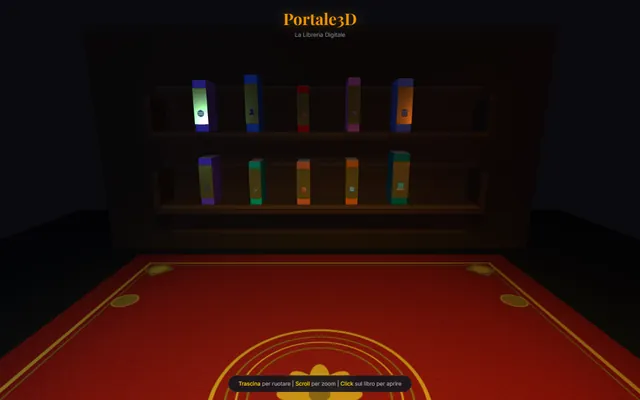
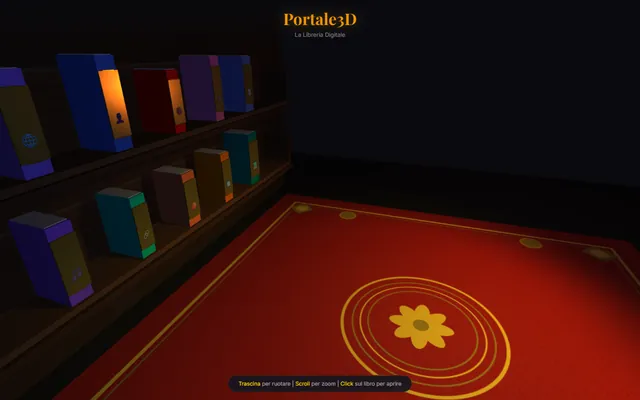
This experiment started from a simple question: how accessible is it today to build a navigable 3D environment without downloading anything, using only what a modern browser offers through WebGL? The answer is a first-person explorable room, with lighting, objects and real perspective, that opens in a tab like any other web page.
A testing ground, not a game
It's not a proper game, and doesn't want to be: it's a technical testing ground. It existed to answer a set of practical questions before taking on more ambitious projects — how do you move a camera so it feels natural? how do you stop the player walking through walls without an off-the-shelf physics engine? how far can you push the scene before performance collapses on an ordinary laptop? The skills worked out here later fed into the games published in the portal's Games section, from Helios to Intercity HUB.
The hard parts
Three problems in particular made the experiment interesting. The first is camera control: making looking around and walking feel right is a matter of small details — speed, inertia, look limits — that, if wrong, give you digital «seasickness». The second is collisions: with no external physics engine, keeping you from sliding into a wall means writing by hand the logic that governs where the body can and can't go. The third is performance: keeping the animation smooth even on modest hardware forces you to be frugal on every single frame.
Why without an engine
Choosing WebGL and plain JavaScript, without leaning on a heavy graphics engine, isn't masochism: it's the way to really understand what's happening underneath. An engine hides the matrices, the shaders, the render loop behind convenient commands; doing without them, at least once, forces you to face those mechanisms head-on — which is exactly what makes your later use of the convenient tools more informed. On top of that, with no heavy dependencies, the room loads fast even where a megabyte-sized library would be a problem.
From here on
The 3D room is one of those projects worth more for what they taught than for what they are: a starting point, the first place where 3D graphics in the browser went from «curiosity» to «a tool I know how to use».