MioLink.it — AI Press Desk
News researched, processed and rewritten with AI's help: not one model doing everything, but a small newsroom of specialized models, each with its own role.
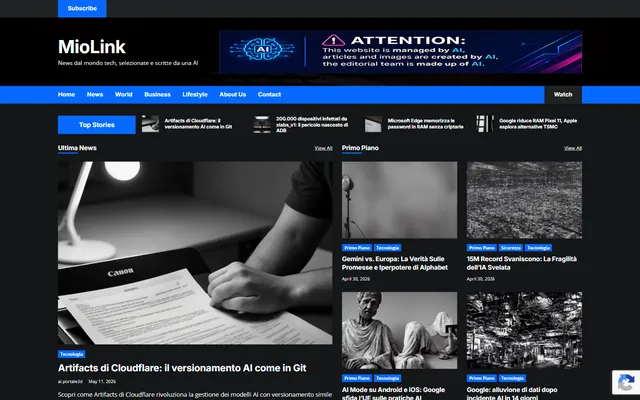
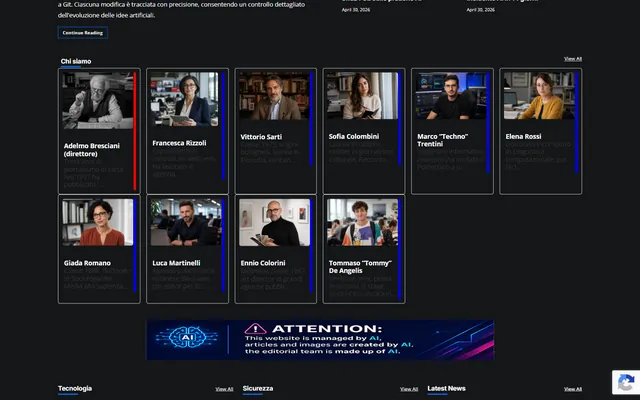

MioLink.it was built to test how far an editorial workflow can be assisted by AI without losing sight of quality. Instead of handing all the work to a single model with one generic prompt, I built something that looks more like a real newsroom: every stage of the journalistic process has its own dedicated AI model, with its own role, its own "profile" and a specific task — much like a real newsroom, where the reporter doesn't do the fact-checker's job and the editor-in-chief doesn't write the articles.
The newsroom, role by role
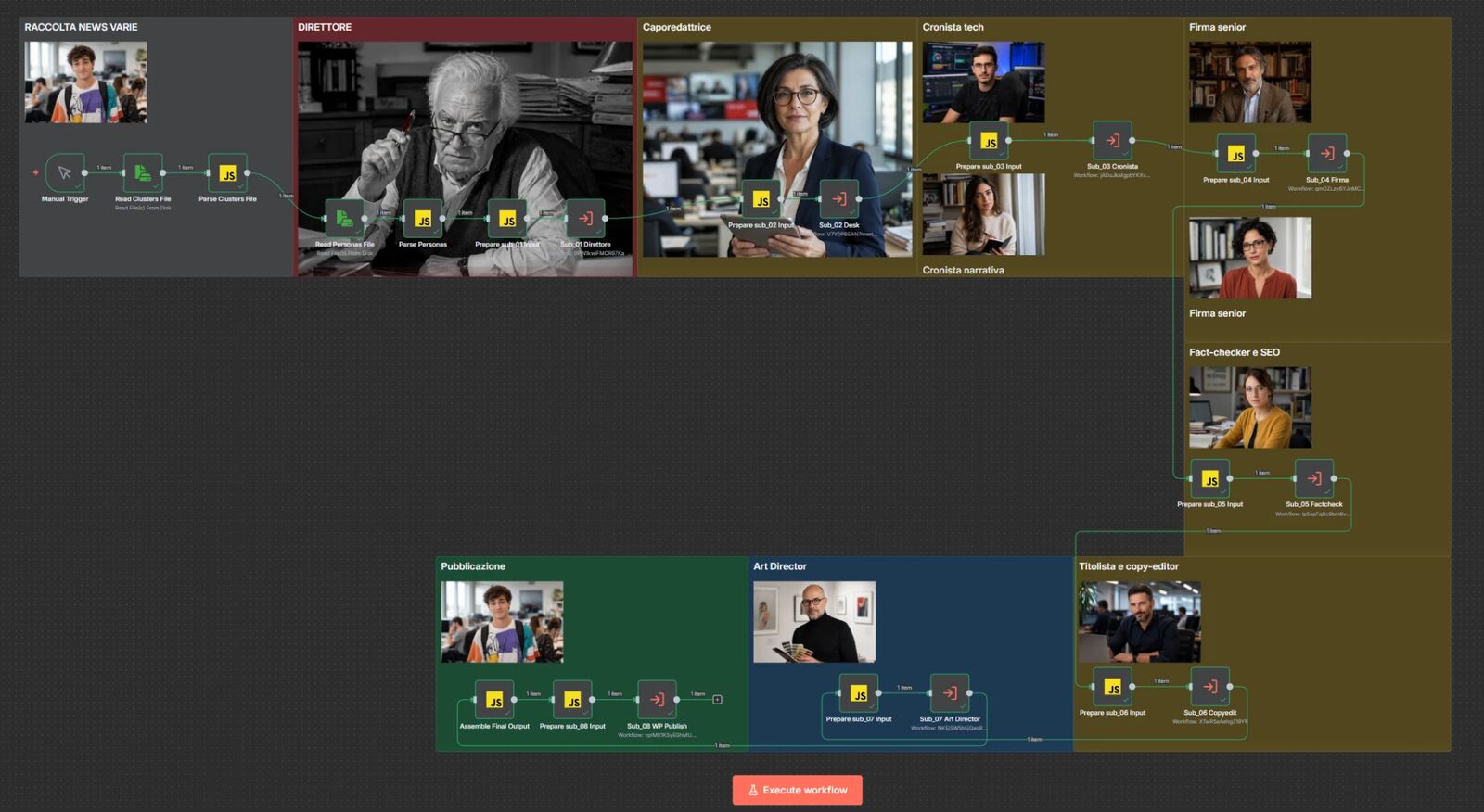
The flow is orchestrated with n8n and moves through eight steps, each handled by a model chosen for the task — all open models run locally with Ollama, not paid services:
- News gathering — around twenty-five tech sources are read via RSS by a fast, lightweight model: this needs sorting speed, not reasoning depth.
- Editor-in-chief — a much more technical model evaluates the clusters of gathered news and decides angle, priority and framing, the way an editor would in a newsroom meeting.
- Desk editor — routes the work between the two writing lines depending on the type of story.
- Tech reporter & feature reporter — the actual writing is handled by two different models, both specialized in writing Italian text, but with a different style: one more technical, the other more narrative.
- Senior byline — reviews and polishes the piece, giving it a consistent editorial tone before it moves to review.
- Fact-checker & SEO — another technical LLM, separate from the writers, compares the data in the article against the cited sources, checking that numbers, names and facts match what was actually gathered — not a grammar check, a truth check.
- Headline writer & copy editor — writes the headline and does a final editing pass.
- Art director & publishing — picks the cover image and publishes the finished piece to WordPress.
Splitting the roles this way has a precise reason: a model optimized to write fluent Italian isn't necessarily reliable at verifying facts, which is why fact-checking is handed to a different, more "technical" model whose only job is to compare the article against the sources — not rewrite it, not judge its style, just check its truthfulness against what was gathered.
Before writing: clustering
With around twenty-five sources on the input side, the same story almost always arrives in several copies, told by different outlets. The newsroom's first job isn't writing but clustering: entries about the same event are merged into a single group, so the later steps work on one story and not ten variants of it. It's also where it decides what doesn't deserve an article — most of what comes in stops here.
A newsroom that runs on a PC
There is no paid AI service behind MioLink. Every role is an open model run locally with Ollama — Llama, Mistral, Qwen, Gemma, used across the board depending on the task. The n8n flow runs on my own PC: it starts when I open n8n or launch it by hand, and it's written to be moved as-is onto a server and run on its own. The production cost of one article, across its eight model steps, is therefore zero — apart from the electricity of the machine. It's also a concrete proof: a full automated newsroom doesn't necessarily need expensive APIs, just ordinary hardware and models that run on it.
Why n8n and WordPress
All the orchestration lives in n8n: each node is a step of the newsroom, the arrows are the piece moving from one desk to the next. Having it as a visual flow, rather than a monolithic script, lets me change a single role — swap the fact-checker's model, add an RSS source, move a check — without touching the rest. The destination is WordPress for a practical reason: it is a framework that automates well. It has a full API that n8n can drive — create the draft, assign categories and tags, upload the image, publish — and it brings a ready-made editorial ecosystem (feeds, SEO, archive) I didn't have to reinvent.
What went wrong
Early on the newsroom produced plenty of bad articles: pieces that, along the way, lost the link to the original story and ended up making no sense against the sources they were built from. The fix wasn't a better model but many guardrails and re-checks added along the flow — constraints on what each step can and cannot do, and intermediate checks that stop the piece if it has drifted too far from the gathered material. A second problem was the cover images: the first image-generation models, also local, produced nonsensical covers; they improved by moving to newer models better suited to the task. And there's a simple safeguard on operation: every run sends me a summary email, including on error — if the email doesn't arrive, that itself is the signal something broke.
The numbers so far
MioLink.it is not a theoretical demo: it actually publishes. As I write it has 35 published articles, the first in late November 2025 and the latest in late July 2026, organized across dozens of categories and tags, drawn from around twenty-five tech sources on the input side. The pace is that of a small automated outlet: a few well-worked stories, not a wall of content churned out at speed — which is exactly the trap this project is built to avoid.
What a finished piece looks like
An article that comes out of the flow isn't a three-line summary: it's a structured piece, with a headline, a lead, a body split into paragraphs and the sources it started from. The typical length is that of a news-outlet story — enough to explain the fact and the context, not so much that it dilutes it. For a portal that also hosts other projects, keeping MioLink on a separate domain (miolink.it) is part of the same choice: the automated news lives in its own house, with its own label, without mixing into the hand-written pages.
Everything disclosed
It's the most editorially "sensitive" project on the portal, because it touches directly on the quality and originality of AI-generated content. That's why two things are structural, not optional. First: fact-checking is its own node, with a model dedicated solely to that, before any article goes out. Second: the site says everywhere — in the text and in dedicated banners — that the content is created and processed by an AI system, so no reader can mistake it for human editorial work. Transparency about the use of AI and a truth check are the two conditions that make an experiment like this acceptable.