Modelli Ombra
Making of an isometric tactical stealth game: from a one-evening Canvas 2D prototype to Godot 4 in the browser, with a level editor that shares the game’s format.
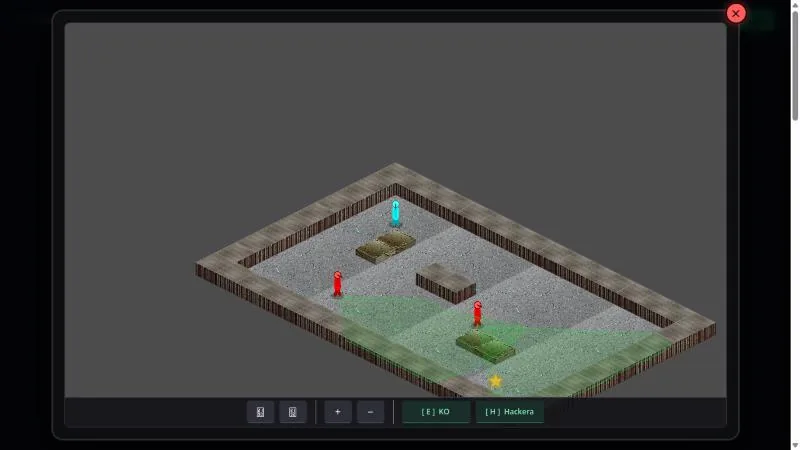
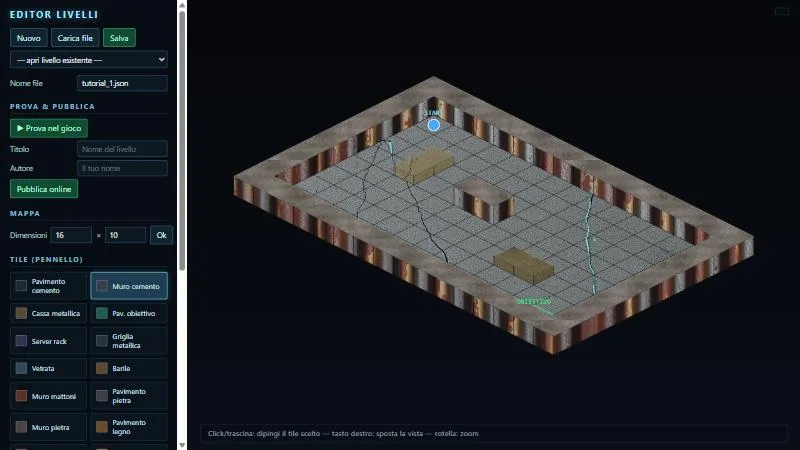
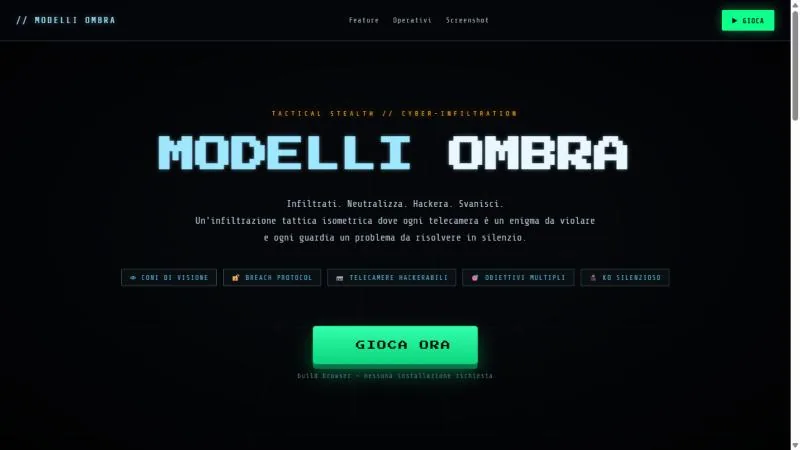
Modelli Ombra is an isometric tactical stealth game with a cyberpunk theme: a single agent, infiltrations into server farms and industrial complexes, guards to avoid or quietly take down. The inspirations are openly stated: the sight cones of Commandos and Desperados, the readability of Mark of the Ninja, the hacking of Invisible Inc.
Three design rules
- Readability first: the player must always understand why they were spotted.
- One agent, many tools: no squad management, but several ways to solve the same room.
- The level is the author: the editor uses the same engine and the same data format as the game.
From a one-evening prototype to Godot
The first version was built to be playable the same evening: dependency-free Canvas 2D, a hand-computed 2:1 isometric projection (64×32-pixel tiles) and sight cones built with grid raycasting. Once it was clear the game worked, the engine was moved to Godot 4 and exported for the web: 18 GDScript scripts, around 2,700 lines, with a signal-based vision system, a state-machine AI for the guards, grid pathfinding that stops you from cutting corners diagonally, and a dedicated isometric renderer.
Seeing and being seen
Every tile has an obstacle height: 0 none, 1 low, 2 full. A low wall hides the agent only when lying down; a full wall always blocks. Glass panes are the interesting case: they block movement but not sight. Guards walk back and forth, loop around closed paths or stand still as sentries, and their cones are cut by the map’s real obstacles.
Hacking in fifteen seconds
Cameras and terminals are breached through a minigame inspired by the breach protocol: a 4×4 matrix of hexadecimal codes from which you pick, alternating rows and columns, the right sequence before 15 seconds run out. While you hack, the rest of the scene is paused.
An editor for the community
The level editor runs in the browser and writes the same JSON the game reads: tile palette, mouse painting, agent, goal and guards with their waypoints, instant testing and online publishing, where community levels become playable for everyone. It is the part meant to outlive the demo: the planned next steps are reconnaissance drones, more height levels and guards that pass the alarm on to each other.